
A campus placement drive is a recruitment event in which companies visit a college, or conduct the process online through the college, to test and hire final-year students for jobs that start after graduation. The college’s training and placement cell invites companies, shares student details and organises the rounds, which usually include a pre-placement talk, an aptitude test, technical and HR interviews, and finally an offer letter. Understanding how a campus placement drive works helps you prepare the right things at the right time instead of panicking in the last semester.
Key takeaways
- A campus placement drive is organised by the college’s training and placement cell together with visiting companies.
- Typical rounds are pre-placement talk, online aptitude and coding test, group discussion in some companies, technical interview and HR interview.
- Companies set eligibility rules such as minimum percentage or CGPA and no active backlogs, so check them before registering.
- A pool campus drive brings students from several colleges to one venue or one online test for the same company.
- Strong basics, a clean one-page resume and practice with aptitude and interview questions matter more than last-minute cramming.
Campus hiring in numbers
- India’s technology industry was expected to add about 135,000 people in FY26, up slightly from 133,000 in FY25, with revenue reaching about $315 billion, according to NASSCOM figures reported by Business Standard. Hiring is growing, but slowly, so preparation matters.
- The India Skills Report 2026 found engineering (BE/BTech) graduate employability at 70.15%, with computer science engineers at 80% and IT engineers at 78%.
What is a campus placement drive?
In a campus placement drive, employers come to students instead of students applying one by one. Companies get access to a large group of freshers in one go, and students get structured opportunities without searching job portals. Drives are common in engineering, MCA, MBA, BCA, BSc and other professional courses across India.
The process is managed by the Training and Placement Officer (TPO) and the placement cell, often with student coordinators. They maintain a calendar of companies, collect resumes, share eligibility rules and make sure the rounds run smoothly.
Types of placement drives
| Type | What it means |
|---|---|
| On-campus drive | The company recruits only from your college, at the campus or online through your college |
| Pool campus drive | Students from several colleges attend one combined drive at a host college or online |
| Virtual drive | All rounds, including tests and interviews, happen online |
| Off-campus drive | The company hires freshers directly through its careers site or hiring events, outside the college process |
| Internship drive | Companies select students for internships, sometimes with a pre-placement offer at the end |
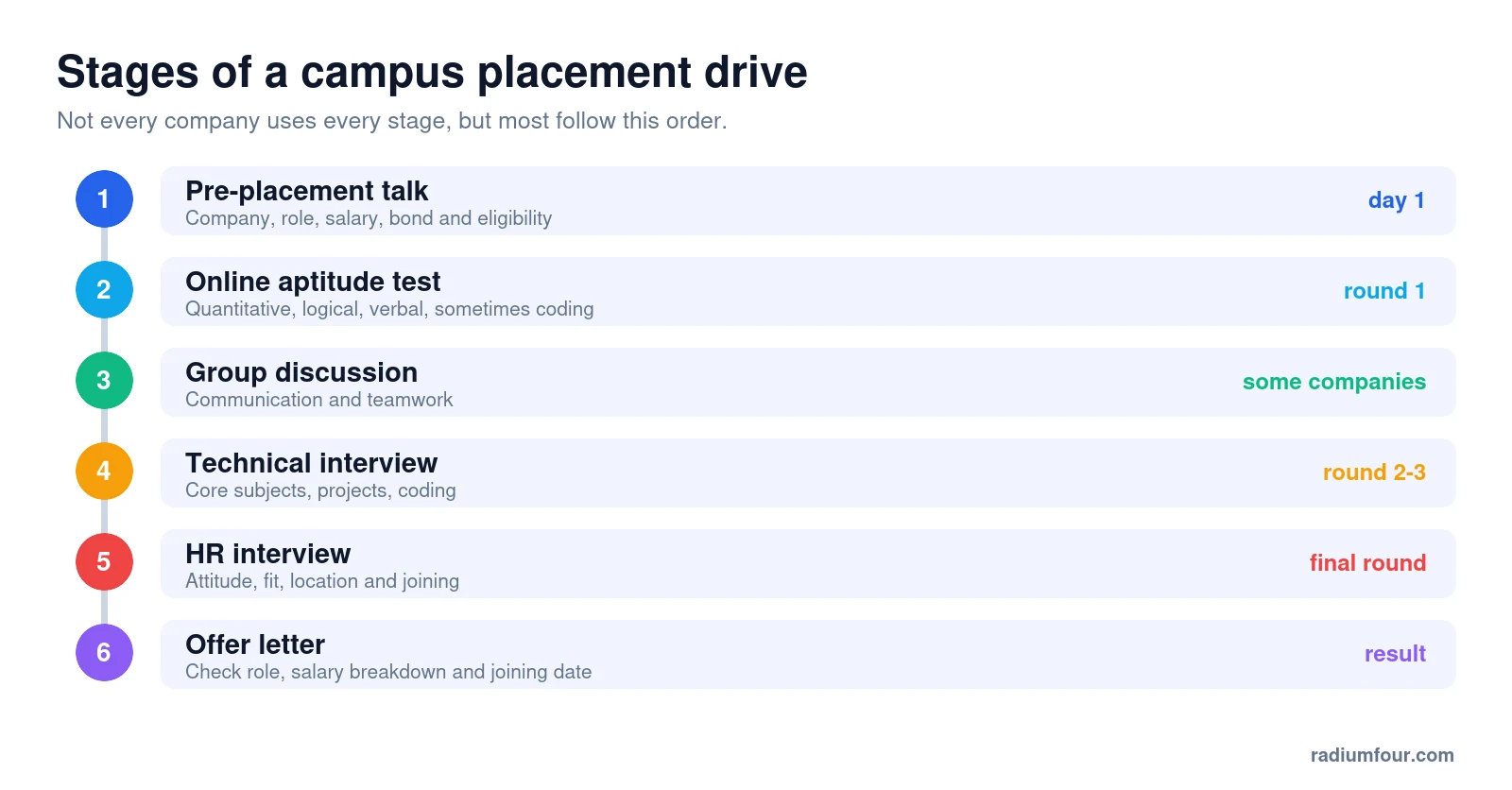
Stages of a campus placement drive
1. Registration and eligibility check
The placement cell announces the company, the role, the expected location and the eligibility criteria. Common criteria include a minimum percentage in 10th, 12th and graduation, no active backlogs and sometimes specific branches. You register through the college portal or a link shared by the company.
2. Pre-placement talk
The company presents its business, the role, training plan, work locations and joining process. Attend carefully and note details; they are useful in the HR round and help you decide whether the job suits you.
3. Online assessment
This round usually tests quantitative aptitude, logical reasoning and verbal ability. IT companies often add coding questions or technical multiple-choice questions on programming, databases, operating systems and networks.
4. Group discussion
Some companies, especially for non-technical or client-facing roles, run a group discussion to check communication, clarity of thought and teamwork. Not every company includes it.
5. Technical interview
Interviewers ask about your core subjects, the programming language you know best, your final-year project and anything on your resume. Be ready to write simple code or explain logic on paper or a shared screen.
6. HR interview
The HR round checks attitude, communication, career goals and fit. Expect questions such as tell me about yourself, why this company and are you willing to relocate.
7. Results and offer letter
Selected students are announced through the placement cell. The offer letter or letter of intent arrives later and lists the role, joining date and terms. Read it carefully, including any service agreement or bond, before accepting.
College placement rules you should know
Each college sets its own policies, so read your placement handbook. Common rules include:
- One offer or dream company policy: after you accept one offer, you may be allowed to sit only for companies offering a higher package or a dream category.
- Attendance rules: missing a registered drive without reason can lead to a penalty or debarment.
- Accurate details: wrong marks or fake information on the resume can lead to offer cancellation.
How to prepare for a campus placement drive
- Fix your resume first. Keep it to one page with education, skills, projects and achievements. Our guide to the resume for freshers shows a simple format.
- Practise aptitude daily. Percentages, ratios, time and work, probability, number series, blood relations and reading comprehension appear often.
- Revise core subjects. For IT roles, cover one programming language well, plus DBMS, OOP, operating systems and computer networks basics.
- Know your project deeply. Be ready to explain the problem, your role, the technologies, challenges and what you would improve.
- Prepare for HR questions. Practise honest, specific answers using our list of HR interview questions for freshers.
- Do mock interviews. Practise with friends, seniors or faculty and ask for direct feedback.
- Keep documents ready. Mark sheets, ID proof, photographs and printed resumes should be in one folder.
What to do on the day of the drive
- Reach early, or log in early for virtual drives and test your camera, microphone and internet.
- Wear clean formal or smart casual clothes unless told otherwise.
- Listen to instructions carefully, especially for online test rules.
- If you do not know an answer, say so and explain how you would find it.
- Stay polite with everyone, including coordinators; companies notice behaviour.
Worked example: one candidate’s placement week
Here is how a typical drive for a mid-size IT services company might run for a final-year student (an illustrative example):
- Monday: the pre-placement talk explains the role (graduate engineer trainee), salary breakdown, a one-year training period and a list of possible job locations. You note the bond terms and the in-hand salary, not just the headline CTC.
- Tuesday: a 90-minute online test: aptitude, logical reasoning, English and two easy coding questions. About a third of students clear it.
- Wednesday: technical interview. You are asked about your final-year project, OOP concepts, one SQL query and a simple array problem.
- Thursday: HR interview: “Why our company?”, “Are you open to relocating?” and “Where do you see yourself in three years?”
- Friday: results. If selected, read the offer letter carefully before accepting, especially if your college has a one-offer rule.
Frequently asked questions
What is the difference between campus placement and off-campus placement?
Campus placement happens through your college’s placement cell with companies the college invites. Off-campus placement means applying to companies directly, outside the college process, often competing with freshers from many colleges.
What is a pool campus drive?
A pool campus drive is a single recruitment drive that is open to students from several colleges at once, held at one host college or online.
Can I sit for placements with a backlog?
It depends on the company and your college. Many companies require no active backlogs at the time of the drive, so check the eligibility criteria for each drive.
When do campus placement drives start?
Many colleges start placement drives in the final year, and some begin internship drives earlier. Ask your placement cell for its calendar, because timing differs from college to college.
For internship-focused preparation, see our internship interview questions, and explore more in the career category.
Sources
Figures in this guide come from the sources below. We checked them on 24 November 2026; numbers may change when new reports are published.